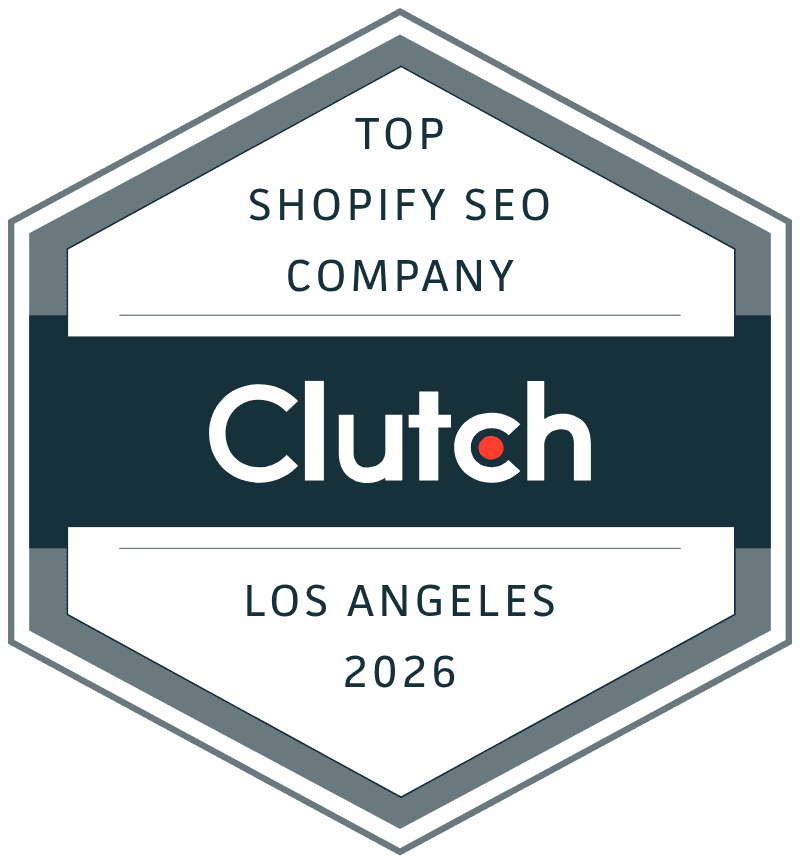
Clutch named Propeller a top Shopify SEO company in Los Angeles
A 2026 Clutch ranking is a useful filter when every pitch says “technical SEO.” It is not a substitute for collection architecture, product data, and a storefront that can actually rank.

Clutch’s 2026 lists put Propeller among the top Shopify SEO companies in Los Angeles. Treat that as a shortlist signal, not a victory lap. Los Angeles has no shortage of agencies that can write a meta title. Far fewer will sit in the theme, the taxonomy, and the redirect map until commercial URLs deserve to rank.
Propeller is a Santa Monica commerce agency. We build and grow Shopify storefronts - and we treat ecommerce SEO as part of that system, not a content retainer bolted on after launch. The badge is public. The work is too. Read the Clutch profile, then judge the catalogs.
What a Clutch ranking measures - and what it does not
Clutch compiles verified client reviews and market presence. That is useful when you are comparing firms that all claim the same stack. It is not a substitute for asking how a partner ships collection architecture inside Shopify, how they handle faceted URLs, or who owns the 301 map on a migration. Rankings get you onto a list. They cannot decide whether `/collections/` is a revenue surface or a thin grid with duplicate copy.
We do not invent a numeric rank or review count here. If you want the source of record, it is on Clutch. What we will own in this article is the work: how Propeller approaches Shopify SEO from a Los Angeles studio, and what that looks like on live catalogs.
Shopify SEO is a store problem
Most Shopify SEO pitches are blogs, apps, and title tags. Category revenue ranks on collection pages. Product data, canonicals, facet crawl paths, and internal links decide whether Google - and AI-search - can understand the catalog. That is systems work: templates, metafields, merchandising, and schema. It is not a calendar of “10 tips” posts hoping to leak equity downward.
We wrote the operating version of this in Shopify collection SEO architecture: one primary keyword per collection, unique copy above and below the grid, sane canonicals for filters, and navigation that actually points at the money pages. An ecommerce SEO agency that will not open Liquid or metafields is selling you a brochure.
Proof from catalogs, not from the badge
When we built the US Shopify foundation for Jinro, organic sessions moved +54% because catalog depth, feeds, and merchandising were treated as one system. Feed coverage at 100%. Catalog depth 3×. Spirits ecommerce has constraints - age-aware flows, education, competitive beverage search - and none of that is solved by publishing more blog posts. Organic and social discovery had to land in the same catalog.
Pacifica Hotels needed merchandise commerce that could survive a hospitality catalog across properties. Organic traffic +39%, with SEO sitting next to integrations rather than in a slide at the end. Guest-facing merch only ranks if the information architecture is honest and the URLs stay stable while ops systems move underneath.
High-consideration catalogs obey the same physics. Sonny Robotics is not an SEO case first - but LLM and AI-search visits above 15,000 in four months came from structured product data, not from hoping a homepage would explain a $14,000 cart. If you are hiring for Shopify SEO in Los Angeles, ask whether the team can talk product data without reaching for a content calendar.
Los Angeles is an operating context, not a keyword
LA brand teams expect craft and commercial rigor in the same room. A Los Angeles Shopify agency that cannot talk metafields, schema, and landing quality will spend your organic gains on a soft PDP. Propeller works from 1541 Ocean Ave in Santa Monica and ships nationally. Local is for workshops and taste. Architecture is for the catalog.
That split matters when you are comparing a Santa Monica studio with a generic “SEO company in Los Angeles” that has never owned a Shopify collection template. We live in the theme. We merchandise for search. We connect ecommerce SEO to CRO so the URL that ranks can also convert. Ranking a page that cannot close is just expensive traffic.
What we refuse to sell as Shopify SEO
We will not rank a thin collection by cloning the same paragraph across fifty URLs. We will not dump leftover redirects onto the homepage and call the migration safe. We will not treat AI-search as a separate product while leaving product JSON-LD and titles sloppy. And we will not run a blog program as a substitute for taxonomy. Editorial can support commercial intent - it cannot replace the pages that convert.
If a pitch leads with “content velocity” and never opens the collection template, you are buying a magazine, not a commerce SEO system. Propeller’s Growth practice sits next to the people who ship the theme. That is the difference between a Los Angeles SEO vendor and a Shopify agency that still owns the URL after launch.
Questions that expose a Shopify SEO partner
A polished audit deck will list tools. Ask questions that reveal who actually owns the store after the report lands.
- Who edits collection templates and metafields - your SEO pod, or a separate theme vendor you will have to coordinate?
- What happens to parameterized filter and tag URLs? Which ones deserve to rank, and which get noindexed or canonicalized?
- How do you protect organic equity in a Shopify migration - one-to-one 301s, or a homepage dump?
- Where does paid traffic enter the same information architecture, so SEO and media are not fighting over two versions of the catalog?
- Can you walk a live collection page you are willing to defend - keyword, copy, canonical, internal links - not a generic screenshot?
The ranking opens the door. The catalog has to earn it.
If you are hiring a Shopify SEO company in Los Angeles, use Clutch to filter noise - then hire the team that will still own collection architecture, product data, and measurement after the kickoff deck. Propeller is built for that: Commerce, Experience, Growth, and Technology as one system, from Santa Monica.
Start a project if the catalog is the product and search is how ambitious brands get found. Or read how we structure collection SEO before you book another content sprint.
9 min read · 3 parts
Questions
Did Propeller win a Clutch Shopify SEO ranking in Los Angeles for 2026?
Yes. Clutch recognized Propeller as a Top Shopify SEO Company in Los Angeles for 2026. See the badge on this page and our Clutch profile for the listing of record. We do not invent numeric ranks or review counts here.
What does a Shopify SEO company in Los Angeles actually do?
The work that moves revenue is collection and product architecture, technical SEO inside Shopify, internal linking, schema, and content that supports commercial intent - not a blog calendar bolted onto a broken taxonomy.
Is Propeller only a local SEO shop?
No. We are a Santa Monica / Los Angeles commerce agency. SEO sits inside Shopify builds, CRO, and growth. We work with brands in LA and nationwide.